Workspaces have evolved significantly over the years, shifting from entirely hierarchical environments with separate offices and managers in private, closed rooms to more open and flexible spaces that facilitate communication and interaction both among colleagues and across different levels of the company hierarchy. So, where do we stand now, and what are the approaches and trends for the new workspaces that we are already beginning to see?
Flex Offices and Open Spaces: Two Trends for Modern Times
The Anglo-Saxon terms “flex offices” and “open spaces” encompass and summarize this new vision of open, flexible, and connected working environments.
Specifically, a “flex office” refers to workplaces or coworking spaces where clients rent a space of the size they consider appropriate and with the layout they desire. Private offices, open areas, meeting rooms, small breakout areas… offices tailored 100% to the consumer’s liking.
They are especially popular among start-ups, freelancers, and small-infrastructure companies seeking total flexibility, low costs, and anticipated workforce geographical mobility.
On the other hand, so-called “open spaces” are open areas within corporate offices (in this case, typically located within the company’s own facilities) where shared areas predominate, with no divided spaces, walls, cubicles, or private offices, creating a more interactive, connected, and productive environment among company employees.
New Workspaces at the ORGATEC 2024 Trade Fair
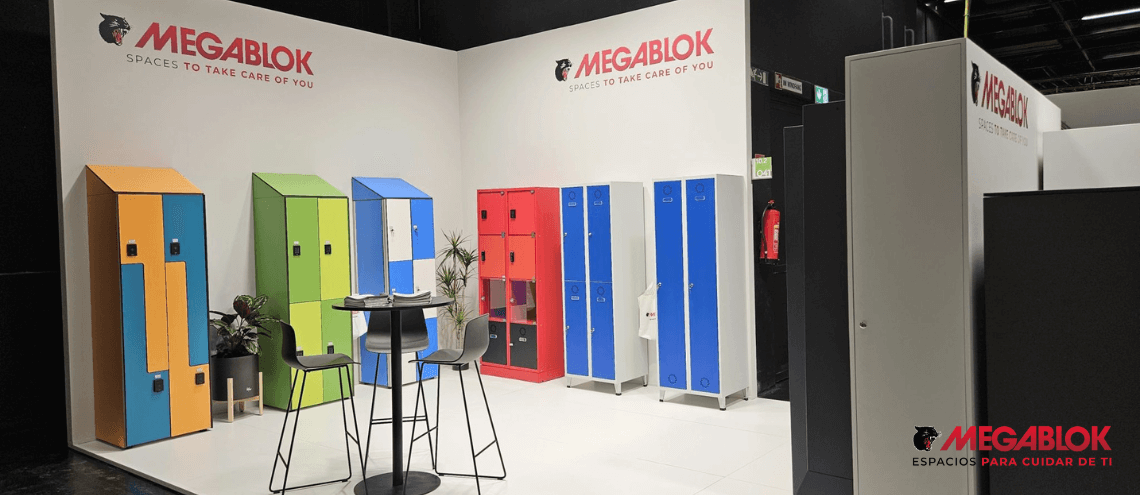
Megablok was present last month at ORGATEC, the leading international trade fair for office equipment and new workspaces, held in the German city of Cologne.
Various conclusions were drawn there that clearly highlighted the aforementioned new approaches, which can be summarized as follows:
- The rise of more connected and shared workspaces, aiming to promote both employee productivity and personal well-being.
- The advancement toward employee work-life balance and harmonization, featuring technological solutions such as smart parcel lockers so company staff can receive personal purchases at company facilities and pick them up at the end of their workday.
- The trend toward hybridization, featuring new shared workspaces where every chair, desk, locker… is used by different workers at different times, requiring modular and smart solutions for this new flexible scenario.
- The commitment to sustainability and the use of recyclable materials.
- The overall “less is more” approach, as all the above require efficient space management that achieves the various productivity, well-being, work-life balance, security, and sustainability objectives sought by these new working environments.
Megablok, furniture adapted to new workspaces
Megablok is a pioneer in implementing workspaces that combine all these objectives, something that is already evident from our main claim or slogan, where we make it clear that we do not simply sell lockers, deposit lockers, or benches, but rather create secure, healthy, and connected spaces. Without forgetting the pillar of sustainability.
Specifically, we could divide our solutions into three distinct main categories, which are:
- Smart parcel lockers for businesses and offices (through Megablok’s most technological line, called Community Locker).
- Cubic Series, furniture for open-plan office areas or “open spaces,” available in both its traditional version and the smart cubic modality, which adds a QRcode and mobile device charging capabilities so that these spaces can be utilized by multiple workers across different work shifts.
- Traditional lockers adapted to various environments and conditions, such as Monoblok metal lockers for dry areas or phenolic lockers for environments with higher humidity.
As we can see, working environments are living spaces that evolve and change over time, adapting to the new business and social realities that each moment requires. At Megablok, we provide the solution you need. Do not hesitate to contact us so we can help you.